
Roof Insurance Claims in Georgia: What Every Homeowner Needs to Know
If a storm has just gone through your neighborhood and you suspect your roof took damage, two numbers are worth knowing before you do anything else:
One year: That is how long most Georgia policies give you to file a roof insurance claim, counted from the day of the storm.
Seven thousand dollars: The average amount added to a roof claim after the first estimate, once someone finds the damage that first estimate missed.
Those two numbers are why the first inspection should not be the last word. Some of the most important damage isn't visible from the ground. Here's what a general contractor looks for that can change the scope of a roof claim.
How Long You Have to File a Roof Insurance Claim in Georgia
Most policies give you one year from the storm date to file, but check your policy paperwork carefully-this timeline is set by your insurance provider, not state law.
However, a second, shorter deadline often catches homeowners off guard:
Most policies require you to report damage within 30 to 60 days of discovering it, even though the total claim deadline is a year out.
If you wait six months to call your insurer, they may argue that the delay made it impossible to prove the recent storm caused the damage rather than normal wear and tear.
Hail and wind damage frequently do not leak right away. A severe storm today can easily turn into a hidden ceiling stain six months down the road.
What a First Roof Estimate Leaves Off
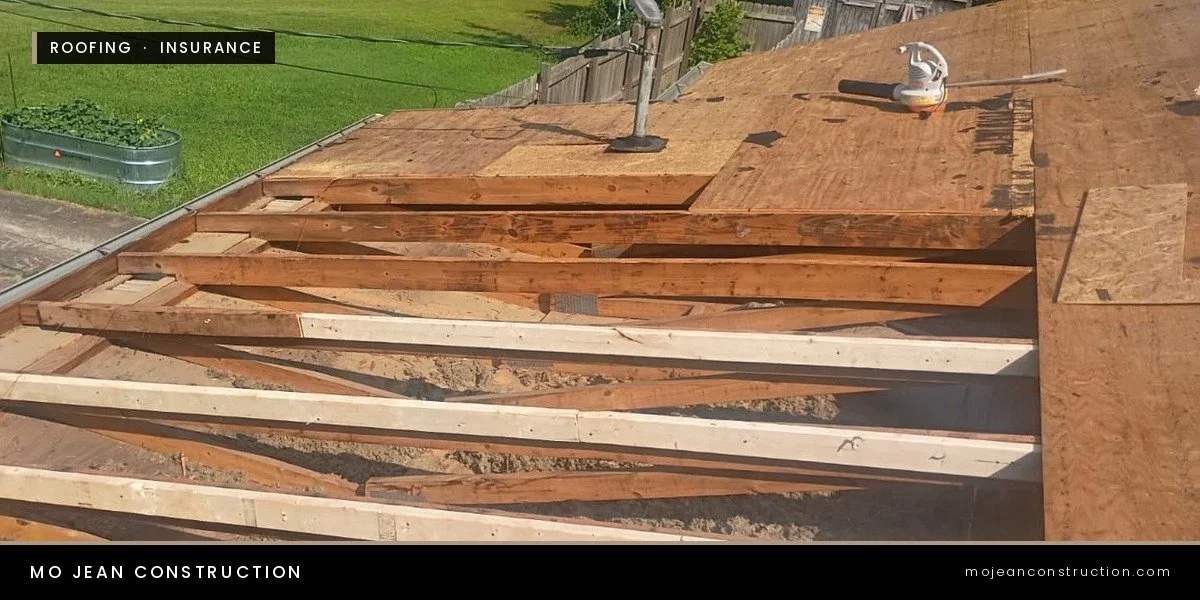
Adjusters move fast after a storm, and most first estimates now come from aerial photos. Aerial photos measure a roof well. They can't see rotten wood under the shingles, a failed seal around a chimney, or a stain spreading across a bedroom ceiling on the other side of the house.
Here's what usually gets added once the roof is actually opened up:
Wood under the shingles: $75–$125 per sheet. Invisible until the old roof comes off, and usually the single largest addition to a claim.
Code-required upgrades: $800–$2,500. New underlayment, edging and vents your roof needs to meet today's code. Covered by most policies, but only under the "Ordinance or Law" section, and only if you ask for it.
Flashing and seals: $400–$1,200. The metal around chimneys, skylights and vents. Missed here, and the roof leaks again within a year even after a full repair.
Interior damage: no fixed range. Ceilings, insulation, drywall, flooring, paint. A roofing company prices the roof and stops there, which is fair, that's their trade. Mo Jean Construction puts both on one estimate instead of leaving the interior for a second contractor.
Domanique Sylvester and the Mo Jean Construction team will walk your property, document structural and cosmetic damage, and provide a comprehensive written estimate for your insurer.
Replacement Cost or Actual Cash Value: The Line That Decides Your Payout
Check the first page (the Declarations Page) of your policy to see how your payout is calculated:
Replacement Cost Value (RCV): Covers the actual cost to install a brand-new roof today. You receive an initial check (minus your deductible), followed by a depreciation check once the work is completed and invoiced.
Actual Cash Value (ACV): Pays only what your aging roof was worth the moment before the storm hit, factoring in depreciation for age and wear. There is no second check. On a 15-year-old roof, an ACV policy can leave you responsible for thousands out-of-pocket.
Review your policy annually. Many insurance carriers quietly convert roof coverage from RCV to ACV once a roof hits 10 to 15 years old.
What a Contractor Is and Is Not Allowed to Do in Georgia
Storm season brings people to your door who will promise things they cannot legally deliver. Three rules are worth knowing.
Contractors cannot act as public adjusters: A general contractor can document damage and discuss scope with your adjuster, but under Georgia law, only a licensed public adjuster or attorney can formally negotiate insurance claims on your behalf.
Contractors cannot absorb or waive your deductible: Any contractor offering to "cover your deductible" or pay you a "sign-on bonus" to offset costs is asking you to participate in insurance fraud.
Your insurer cannot choose your contractor: They may recommend one, but the choice is yours.
A good contractor can document the damage with photographs, meet the adjuster during the inspection, provide a detailed estimate, and document additional damage when it is discovered.
Please Read: Hiring a general contractor in metro Atlanta.
What to Do If Your Roof Insurance Claim Is Denied
Insurers often deny storm claims by categorizing wind or hail impact as pre-existing age and wear. A denial is rarely the final answer.
Request the denial in writing: Ask for the specific policy exclusion clause referenced by the adjuster.
Gather independent evidence: Secure a detailed inspection report with photos alongside historical weather data (hail size and wind speeds) for your area on the storm date.
Submit a formal appeal: Send your documentation back through official appeal channels rather than debating the decision over the phone.
File a state inquiry if necessary: If the insurer handled things unfairly, the Georgia Office of Insurance and Safety Fire Commissioner takes complaints from homeowners.
You can also re-open an existing claim if additional storm-related damage is discovered during tear-off, provided you remain within your policy's filing window.
Covering the Part Insurance Will Not Pay
Insurance policies rarely cover your deductible, voluntary material upgrades (such as stepping up to architectural shingles or standing-seam metal), or repairs unrelated to the storm.
If out-of-pocket costs arise, Mo Jean Construction works alongside trusted third-party financing providers:
Cross Country Mortgage: Options for HELOCs, home equity loans, and renovation financing for large-scale property updates.
Acorn Finance & HFS Financial: Unsecured personal loan options for homeowners looking for competitive monthly payment plans without leveraging home equity.
Read More: Paying for a home renovation without draining your savings
Where Georgia Storms Actually Land
Storm damage in metro Atlanta rarely spreads evenly across a county:
Gwinnett County: The I-85 corridor routinely sees severe hail paths, impacting roofs across Duluth, Lawrenceville, and Dacula.
Paulding County: Sitting on the western edge of the metro area, Dallas and Hiram take the brunt of fast-moving weather fronts with minimal warning.
Henry County: Strong squall lines push straight up from the south through Stockbridge and McDonough.
Cobb County: Areas around Kennesaw and Acworth experience high-wind events that lift older shingle runs and drop heavy pine limbs.
Fulton, DeKalb & Clayton Counties: Wind and fallen trees cause severe structural damage. Older homes built in the 1960s and 1970s across Tucker, Stone Mountain, and Jonesboro almost always require full decking replacements once opened up.
Always record the exact date of the storm. Every claim evaluation centers around that specific calendar date.
One Contractor for the Roof and Everything Under It
A storm claim isn't just a roofing job. There's usually a ceiling to patch, insulation to replace, flooring to pull up. Most homeowners end up chasing three trades around one payout.
Mo Jean Construction is a women led general contracting firm holding LEED, OSHA, CMCI and Energy Star credentials. Our team will inspect the roof, document the damage the way your insurer needs to see it, and give you one written estimate covering the roof and every repair inside.
Has a Storm Come Through Your Neighborhood?
Even if the storm hit months ago and you haven't filed yet, call anyway. You may still be within your one-year window to submit a claim.