Roof Repair or Replacement With a Solid Deck: How to Make the Call
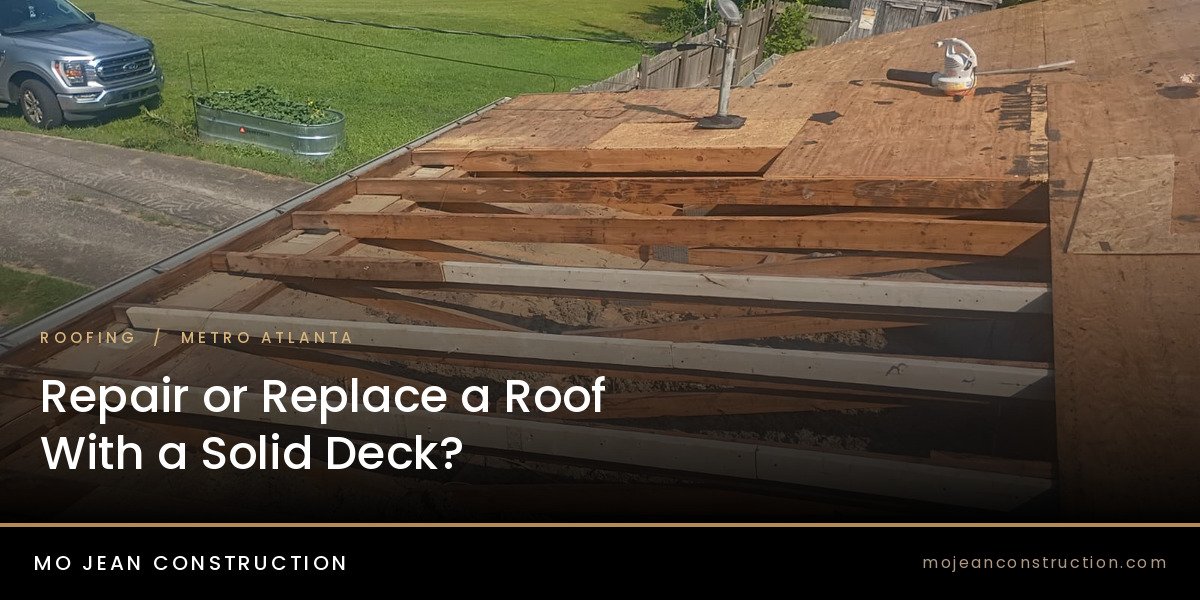
A roof problem doesn't always mean you need a new roof. If the decking beneath your shingles is still in good condition, you may be able to fix the damage without replacing everything. The challenge is knowing which option makes the most sense for your home and your budget.
In metro Atlanta, a typical roof repair averages around $657, while a full architectural shingle replacement on a 2,000-square-foot roof can cost $9,600 to $16,000. Partial replacement falls somewhere in between. Understanding what each option covers can help you avoid spending more than necessary while making sure your roof is properly protected.
What a Solid Deck Changes
The deck is the plywood layer under your shingles. If it is rotted, the decision is made for you: the whole roof comes off.
When the deck is solid, the problem is limited to the surface, such as the shingles, the flashing or the seals around vents. That keeps repair and partial replacement on the table, and your job becomes choosing the fix that gives you the most protection for what you spend.
It also gives you time. Once any active leak is patched, you can compare detailed quotes instead of signing the first one.
Three Ways to Fix a Roof With a Solid Deck
Each option suits a different kind of damage, so start by looking at where yours is and how far it reaches.
1. Repair: For One Problem in One Place
A repair fixes a single, specific fault and leaves the rest of the roof untouched. Common examples are a cracked rubber boot around a vent pipe, loose flashing where the roof meets a wall, or a few shingles torn off by a strong gust.
Repair is the right choice when the contractor can show you exactly what failed and why, and the rest of the roof is in good shape.
2. Partial Replacement: For Damage on One Side of the House
A partial replacement redoes one full slope while the others stay in place. It fits when damage is concentrated on one side, such as where a limb hit the back slope or where the side facing the afternoon sun has worn faster than the rest.
Before you agree to a partial replacement, ask three questions:
Can the shingle still be matched? New shingles look brighter than older ones until they weather.
Where will the new section meet the old one? That joint needs careful flashing so it does not become the next leak.
What does the warranty cover? In most cases it applies only to the new section, not the whole roof.
3. Full Replacement: For Problems Across the Whole Roof
A full replacement removes the old roof down to the deck and installs everything new: underlayment, flashing and shingles, all covered by one warranty.
It is the better choice when problems are showing up on several slopes, or when a partial job would leave a patchwork you would redo within a few years. With a solid deck, the job is usually simpler and faster.
Can You Shingle Over the Old Roof?
Building code allows one new layer of shingles over one existing layer. If your roof already has two layers, both have to come off.
Even when an overlay is allowed, it has real downsides. Flashing around chimneys and walls is hard to redo properly through two layers. The extra layer adds weight to the framing. And the next replacement means tearing off two layers instead of one, which costs more. Ask any contractor quoting an overlay how the shingle manufacturer’s warranty treats it.
If two quotes are thousands of dollars apart, check first whether one of them is an overlay.
What Each Quote Should Show Before You Compare
Ask for both options from the same inspection, so the person pricing them saw the same roof.
A clear repair quote names:
The cause of the leak, not just where the water showed up inside.
What is being replaced, such as pipe boots, flashing or a set number of shingles.
How long the work is guaranteed.
A clear replacement quote states:
Tear-off or overlay.
The underlayment and drip edge being installed.
Whether flashing is new or reused.
Whether the permit is included.
Which warranty applies: the manufacturer’s on materials, the contractor’s on labor, or both.
Settling the scope on paper before money is spent is a discipline Domanique also teaches through the We Can Build Too program. For broader vetting questions, see our guide to hiring a general contractor in metro Atlanta.
Want both options priced from one visit?
Domanique Sylvester and the Mo Jean Construction team will inspect your roof and give you a repair quote and a replacement quote side by side, with the scope of each in writing. Call 404-610-9352 or book a time with Domanique.
Local Factors That Can Tip a Close Call
Trees: About 45.7 percent of the City of Atlanta is under tree canopy, and most of those trees stand on single-family lots. Falling limbs cause damage in one spot, which usually points to a repair or partial replacement. Shade encourages dark streaks, which are algae, not rot, and not a reason to replace on their own. Pressure-washing them strips the shingles’ protective granules.
Recent storms: Quarter-size hail hit Cobb, Fulton, DeKalb and Gwinnett in early July, and one-inch hail followed in September. If a storm passed over your home recently, have the roof inspected and documented before paying for any repair.
Permits: Inside City of Atlanta limits, repair work under $2,500 on a single-family home does not need a permit, and a re-roof with no structural changes qualifies for the city’s express permit review. Outside the city, a home in McDonough or Hiram follows its own local building office. Either way, the permit should be your contractor’s job and listed on the quote.
Paying for the Option You Choose
Repairs are usually paid out of pocket. For a partial or full replacement, Mo Jean Construction works with three lending partners.
Cross Country Mortgage offers equity-based products: a home equity line of credit, a home equity loan, and renovation loans for larger improvement projects. Its construction-to-permanent loan is a separate product for ground-up or structural builds.
Acorn Finance and HFS Financial offer personal financing for homeowners who would rather not borrow against the house. Our post on paying for a home renovation without draining your savings explains how these options compare.
Find Out Which Fix Your Roof Really Needs
A solid deck means you are choosing, not being forced. The right fix depends on where the damage sits, what each quote includes and how the numbers compare.
Domanique Sylvester and the Mo Jean Construction team will inspect your roof, explain which option fits and why, and price the alternatives in writing so you can compare them. Roofing sits alongside our residential and commercial property transformations, so we look at the roof as part of the whole house, not on its own.